App discovery has always been a hard problem. The app stores are crowded. Paid user acquisition is expensive. Organic discovery through ASO takes time and is increasingly competitive. Influencer campaigns are unpredictable. And word-of-mouth — while powerful — doesn’t scale.
But there’s a channel that app developers are almost universally ignoring right now: AI assistants. When someone asks ChatGPT, Perplexity, or Google’s AI Overview “What’s the best app for tracking personal finances?” or “Which apps are recommended for remote team communication?” — the apps that get named in those answers get a discovery advantage that’s genuinely unlike anything in the traditional app marketing toolkit.
It’s not replacing the app stores. It’s feeding them.
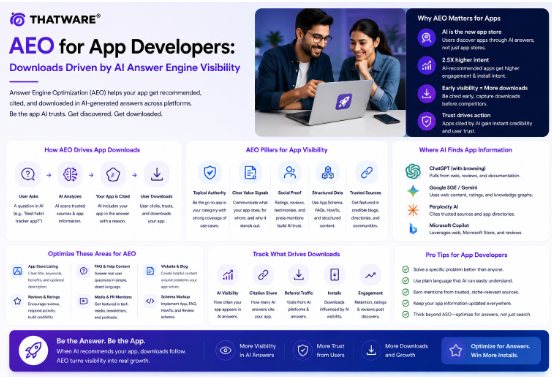
How AI Answers Drive App Downloads
The mechanism works like this. A user asks an AI assistant a question that’s implicitly about finding an app — “how do I manage my freelance invoices” or “what app do developers use for time tracking.” The AI produces an answer that may include specific app recommendations. The user, now with a concrete name, goes to the app store and searches for it directly.
That direct branded search in the app store converts at an extraordinarily high rate compared to discovery-based browsing. The user who arrives at your app store page after hearing your name from an AI assistant already has a soft endorsement — they’ve been told, by a source they trust, that your app is worth looking at. That’s a fundamentally warmer lead than a cold browse.
For many app categories, AI-referred downloads are becoming a significant and growing portion of the acquisition mix — even if most app developers aren’t tracking it as a distinct source yet. The brands that are actively building AI answer visibility are getting an outsized share of this emerging channel.
Working with eCommerce AEO services that have extended their practice into mobile app discovery is increasingly how the most sophisticated app developers are approaching this. The strategies overlap significantly with product AEO — it’s about building the external authority, user validation signals, and content presence that make AI systems willing to recommend your app with confidence.
What Makes AI Systems Recommend an App
AI assistants construct their app recommendations from a combination of sources — review platform signals, coverage in tech media, user-generated discussion in forums and communities, and structured information about what the app does and who it’s for. The apps that consistently get recommended share a few characteristics.
Strong, specific review profiles on multiple platforms. Coverage in authoritative tech publications, ideally with specific feature evaluations rather than just press release summaries. Active, positive user communities on platforms that generate crawlable, AI-accessible discussion. And clear, specific descriptions of what the app does, who it’s best for, and what differentiates it from alternatives.
Notice that “large review volume” is only one factor. Specificity and quality of reviews often matters more than raw count. An AI system constructing an answer about “best project management apps for freelance designers” is looking for apps that are specifically and credibly associated with that use case — not just apps with lots of reviews in the general category.
The Use Case Specificity Opportunity
Most apps are designed for broad audiences. But from an AEO perspective, building specific authority in well-defined use cases is often more valuable than building general authority across a broad category.
“Best app for managing client projects as a freelancer” is a different query than “best project management app” — and the competitive landscape for that specific query is much less crowded. An app that has built clear, credible AI authority for specific use cases will often outperform larger competitors for those specific queries, which can translate into meaningful download volume from exactly the right user segments.
This use-case specificity approach also tends to produce higher-quality users — people who found your app through a specific, relevant query are better-matched to what your app does, which typically means better retention and engagement metrics.
App Content Strategy Beyond the Store
Most app developers think of their content footprint in terms of the app store listing, maybe a product website, and periodic blog posts. From an AEO perspective, that’s thin. The external content ecosystem that surrounds your app — reviews, community discussions, media coverage, tutorials, comparison pieces — is where a significant portion of AI answer authority actually comes from.
Building an AEO strategy for an app means systematically expanding that ecosystem. Getting the app reviewed by relevant niche publications. Encouraging power users to write detailed community posts about their specific use cases. Creating content that directly addresses the “how do I do X” questions that your app solves.
Every AEO agency worth working with will tell you the same thing: the content that supports AI answer inclusion is fundamentally about being present in the places and formats where AI systems go looking for evidence about what your product is and who it’s for.
App discovery is evolving fast. The developers who build AI answer authority now will have a sustainable acquisition channel that doesn’t depend on algorithm changes, paid auction dynamics, or the whims of platform gatekeepers. That independence is increasingly valuable in a world where app store discovery is both expensive and uncertain.